is associated with foundational movements in modern art. We learn about this:
'Everyone remembers his famous dictum of 1890 when he was twenty years old and unknown. "Remember that a painting – before being a battle horse, a nude woman, or an anecdote of some sort – is essentially a flat surface covered with colours, put together in a certain order". This defining statement along with a handful of radical and spectacular works,... have become associated with him to the point where they have obscured the richness of his Nabi and Symbolist period (1889-1898) and his productive classical revival works of the 1900s. They also cast a shadow over his post-1914 work on the fringes of the Avant-Garde movements. Denis continued to paint until his death, and between the wars he was sought after for decorative projects for both civic and religious buildings.
'He always claimed that his constant and sometimes anxious search to accommodate his decorative ambitions gave his work a coherence seen right through from his early symbolism to the later paintings, and even in his numerous writings. For Denis, this coherence was to be found in the systematic and exclusive use of a picture's essential components (plane, colour, composition) alongside the demands of constantly changing subjects, be they linked to his catholic faith, to a description of modern life or to the personal iconography he developed from the 1890s onwards.
....
'From the beginning of the 1890s, the Nabis were, according to Verkade, calling for "walls, walls for decoration". Denis painted ceilings and panels ... in imitation of a tapestry.
'Denis frequently used to recount the origins of the Nabi movement, created in the aftermath of the furore provoked by the Talisman (Paris, Musée d'Orsay, former Maurice Denis collection), a small landscape with an emblematic title painted by Sérusier under the guidance of Gauguin. Along with Puvis de Chavanne, Fra Angelico and the Ingrists, Sérusier was a seminal figure for the young Denis. Like his Nabi friends, Denis produced more and more small paintings, each more audacious in its application of the new aesthetic: flat surfaces of bright colour, a radical simplification of shapes, absence of perspective, Japanism and Synthetism. ....
'His symbolist compositions and decorative works benefited from this research, which he used for an art which was becoming increasingly monumental and reasoned. His trip to Rome in 1898 with André Gide confirmed the move towards a classical revival, encouraged by the art of Raphael and Cezanne....
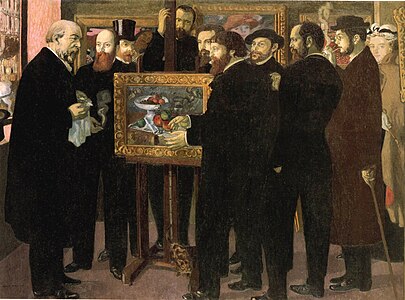
'Other equally important features both in Denis' work and in early twentieth century art are the strict rules for composition, a restricted use of colour, the importance of drawing: notable in key works like Hommage to Cezanne (Musée d'Orsay), in the large decorative panels, like A Game of Shuttlecock (Ibid.) or Virginal Printemps (private collection), a major painting never exhibited in a French gallery since 1945, but also seen in the family scenes, inspired by the happiness he found with Marthe. By this time Denis was a well-known, revered and highly sought-after artist. His work was sold by Vollard, Druet and Bernheim and was much favoured by Ivan Morosov and his rival Sergei Shchukin, both eminent Russian collectors of Matisse and Picasso....'
We mention the painting he executed: Homage to Cezanne (1900). Everyone in this painting is an actual historical personage; the lady is his wife. Surely then the cat in the bottom middle of this portrait is modeled on a real feline.


No comments:
Post a Comment