The Book, Cat, & Cat Book Lovers Almanac

of historical trivia regarding books, cats, and other animals. Actually this blog has evolved so that it is described better as a blog about cats in history and culture. And we take as a theme the advice of Aldous Huxley: If you want to be a writer, get some cats. Don't forget to see the archived articles linked at the bottom of the page.

July 21, 2021

July 21, 1664

Matthew Prior   (July 21 or 23, 1664 to September 18, 1721) was an English poet.

Here is an excerpt from

WHEN THE CAT IS AWAY, THE MICE MAY PLAY.

....
A Lady once (so stories say)
By rats and mice infested,
With gins and traps long sought to slay
The thieves; but still they 'scap'd away,
And daily her molested.

Great havoc 'mongst her cheese was made,
And much the loss did grieve her:
At length Grimalkin to her aid
She call'd (no more of cats afraid),
And begg'd him to relieve her.

Soon as Grimalkin came in view,
The vermin back retreated;
Grimalkin swift as lightning flew,
Thousands of mice he daily slew,
Thousands of rats defeated.


....


The picture above was ancient long before the poet was born. His intent here is a satirical comment on the some political scene in England. His grace as a writer is spoken of and this certainly illustrates that.

Matthew Prior was a famous poet in his time, and not really forgotten til the last century. This line from a long biographical article at poetryfoundation.org  perplexes:

Matthew Prior was the most important poet writing in England between the death of John Dryden (1700) and the poetic maturity of Alexander Pope (about 1712). 

I guess I didn't think of importance as something measureable  by decade. According to this source:

He was particularly important in his own century in England for two accomplishments: he helped to keep alive as a lesser current, in the main current of polished Augustan couplets, the Restoration gifts of lyricism and levity in tone and of octosyllabics and anapests in metrical form; and the tremendous financial success of his 1718 Poems on Several Occasions, with its 1,446 subscribers paying half the price of the edition in advance, helped to teach his fellow poets a significant economic lesson—that it was possible to support oneself handsomely by relying on the reading public in general rather than on one titled patron.

That praise is a bit pinched. Or so it seems; this is a world that has disappeared.  From his biography:

Prior later praised the training he had received at Westminster, particularly in the making of extemporaneous verses and the composing of declamations in a short length of time.

His was a different world, with standards we have forgotten.  And yet a world like our own, where even the religious, can say with Matthew Prior, they are “unable to explain / The secret Lab’rynths of Thy Ways to Man.... “


July 31, 2020

July 31, 1901

JULY 31, 201


Jean Dubuffet's dates are July 31, 1901 to May 12, 1985. His print Angry Cat (Chat Furieux) is at MoMA. This is the catalog information:

November 1953. Lithograph, composition: 10 15/16 x 16" (27.8 x 40.7 cm); sheet: 15 1/16 x 19 9/16" (38.2 x 49.7 cm). Printer: Mourlot, Paris. Edition: artist's proof before the edition of 20. Gift of Mr. and Mrs. Ralph F. Colin. © 2012 Artists Rights Society (ARS), New York / ADAGP, Paris.

You want to search for it on google images. Dubuffet had the idea he would ignore beauty, in his art, in a struggle against what a friend of his called "the terrorism of the intellectual." What we have left, in this case is "cat."

July 30, 2020

July 30, 1951

David Kynaston (July 30, 1951) was, we read in his Who's Who profile, born in Aldershot, England and is the father of two sons and a daughter. He went to Oxford and in addition to writing histories which focus on modern Britain, he is on the faculty of Kingston University.

His bibliography includes:

King Labour, (1976);
The City of London, vol. 1, (1994), vol. 2, (1995), vol. 3, (1999), vol. 4, (2001); (ed jtly) ;
Austerity Britain: 1945-1951, (2007);
Family Britain:1951-1957, (2009);
Modernity Britain 1957-1962, Book One, (2013), Book Two, (2014)


These vignettes from Family Britain are interesting in themselves, like this discussion of the British awareness of class. 

"The...English had [an appetite] for placing...[others] whose hands, faces, accents, clothes and bearing would, if studied with sufficient attention, reveal valuable items of information...the most important being...[their] social class..."

Kynaston is quoting Dan Jacobson, the writer, and the rest of the quote uses a metaphor for this evaluation activity; it is like "a cat sniffing a person's shoes."

Kynaston sounds unaware of the imprecision of Jacobson's picture. Dogs sniff to determine their position in a pack, and that is presumably Jacobson's point.  Cats have different, simpler, motives for olfactory investigations. The feline may be interested in  the proximity of food, but they are not involved in any pack activity. 

According to Doris Lessing, this awareness of class among her countrymen, was shocking to colonials who arrived in the capital.  

July 29, 2020

July 29, 1750

Laetitia Pilkington (1709 to July 29, 1750) was a prominent figure in Dublin society. She claimed to have been reading a book when armed men broke into her bedroom, and held the man with her, so her husband the doctor could beat him up. She subsequently slipped out of high society; even Jonathan Swift dropped her. (He dropped her husband also, let it be noted). She had tough years before her Memoirs were published and provided some income. It is said they are a valuable source of information about Swift and 18th century Dublin.

Pilkington was a writer and besides her memoirs there is a book she edited titled, Pity's Gift. The full title is Pity's Gift: a collection of interesting tales to excite the compassion of youth for the animal creation Ornamented with Vignettes from the Writings of Mr. Pratt

We quote (I left out the worst descriptions):

Now it is reported by the neighbours of the adjacent village, that the old shepherd, the father, was a mighty odd character, and bred-up his family in a very different manner from his poor neighbours. As he was unable to give them the advantage of an education like ours; and teach them Latin and Greek, he was resolved to furnish them with such accomplishments as his situation permitted. He was a man of tenderness and simplicity, and often spoke to his children in this manner: 


“ Do all the good you can, boys and girls, and be sure you do no harm. You must labour for a livelihood, but you may always get your bread innocently; and the bread that is earned honestly, will be always the sweeter for it. I am myself obliged to attend a flock; your mother is compelled to spin; to the poor sheep we are therefore all indebted ; they afford us food and raiment, they shield us from the cold, and prevent us falling into the jaws of famine. I therefore love the harmless creatures, and would not hurt them for all that they are worth: let this conduct teach you, children, to behave properly to poor dumb animals, and to use them as they deserve to be used. You are their friends, and they are yours. Prove yourselves their protectors; but I charge you presume not to' think you have any right of tyranny; and be assured, wanton cruelty will always be returned upon the tormentor.”....

[N]ow comes the cream of the story, pray therefore attend. The eldest son had one day taken the nest of a Robin, which consisted of five young ones, and a sixth just bursting from the shell. He carried them home to his brothers and' sisters, to each of which he gave a bird; but the little nestling he gave to one of the children...who wrapping it up in a piece of flannel, put it into a small wicker basket, and set it by the fire. 

The boy that found the nest, tied a string to the leg of his bird, and cruelly dragged it after him. ...The third gave his to the cat, or rather pretended to give it, for he held it first pretty close to puss’s whiskers, and then pulled it away from her, but at last she pounced upon it, and carried off one of the legs. ....

[A]bout six or seven months after this, the eldest son (which had been the cause of all this mischief) fell sick, and died; and many people are now living who say, that as he was going to be put into the ground, the ravens, rooks, kites, and other vast birds, all flew over his coffin, screamed, and could by no means be got away, nor could he rest in his grave for them....

That was an interesting example of 18th century morality tales. Here is a link to a biographical sketch of Laetitia Pilkington. Her Memoirs (1748) should be available, but you won't find them free on Google books or, the usually more reliable Hathitrust. The three volumes are available to read on archive.org.

July 28, 2020

July 28, 1804


Ludwig Feuerbach (July 28, 1804 to September 13, 1872) was a German philosopher. His book The Essence of Christianity was first published in 1841 and an English translation appeared in 1855. In this book Feuerbach argues that all our ideas about god are just a reflection of our own human nature. He is a very good writer and his arguments easy to follow, or maybe that reflects the translator, who happened to be the woman who would soon write Adam Bede, Marian Evans.

Our excerpt is from Feuerbach's major book, which we have already cited.


Creation, .... the creative, cosmogonic fiat is the tacit word, identical with the thought. To speak is an act of the will; thus, creation is the product of the Will: as in the Word of God man affirms the divinity of the human word, so in creation he affirms the divinity of the Will: not, however, the will of the reason, but the will of the imagination—the absolutely subjective, unlimited will. The culminating point of the principle of subjectivity is creation out of nothing.'' 
.....
Creation out of nothing is the highest expression of omnipotence: but omnipotence is nothing else than subjectivity exempting itself from all objective conditions and limitations, and consecrating this exemption as the highest power and reality: nothing else than the ability to posit everything real as unreal—everything conceivable as possible: nothing else than the power of the imagination, or of the will as identical with the imagination, the power of self-will...

Creation out of nothing, is identical with miracle, is one with Providence; for the idea of Providence— originally, in its true religious significance, in which it is not yet infringed upon and limited by the unbelieving understanding—is one with the idea of miracle. The proof of Providence is miracle.... Belief in Providence is belief in a power to which all things stand at command to be used according to its pleasure, in opposition to which all the power of reality is nothing. Providence cancels the laws of Nature; it interrupts the course of necessity, the iron bond which inevitably binds effects to causes; in short, it is the same unlimited, all powerful will, that called the world into existence out of nothing. ....

But we nowhere read that God, for the sake of brutes, became a brute—the very idea of this is, in the eyes of religion, impious and ungodly; or that God ever performed a miracle for the sake of animals or plants. On the contrary, we read that a poor fig-tree, because it bore no fruit at a time when it could not bear it, was cursed, purely in order to give men an example of the power of faith over Nature ;—and again, that when the tormenting devils were driven out of men, they were driven into brutes. It is true we also read: "No sparrow falls to the ground without your Father;" but these sparrows have no more worth and importance than the hairs on the head of a man, which are all numbered.

Apart from instinct, the brute has no other guardian spirit; no other Providence, than its senses or its organs in general. A bird which loses its eyes has lost its guardian angel.

... It is true that religious naturalism, or the acknowledgment of the Divine in Nature, is also an element of the Christian religion, and yet more of the Mosaic, which was so friendly to animals.—But it is by no means the characteristic, the Christian tendency of the Christian religion. The Christian, the religious Providence, is quite another than that which clothes the lilies and feeds the ravens. The natural Providence lets a man sink in the water, if he has not learned to swim; but the Christian, the religious Providence, leads him with the hand of omnipotence over the water unharmed.

.....Providence has relation essentially to men, and even among men only to the religious. "God is the Saviour of all men, but especially of them that believe." It belongs, like religion, only to man; it is intended to express the essential distinction of man from the brute, to rescue man from the tyranny of the forces of Nature. Jonah in the whale, Daniel in the den of lions, are examples of the manner in which Providence distinguishes (religious) men from brutes. If therefore the Providence which manifests itself in the organs with which animals catch and devour their prey, and which is so greatly admired by Christian naturalists, is a truth, the Providence of the Bible, the Providence of religion, is a falsehood; and vice versa. What pitiable and at the same time ludicrous hypocrisy is the attempt to do homage to both, to Nature and the the Bible at once I How does Nature contradict the Bible! How does the Bible contradict Nature! The God of Nature reveals himself by giving to the lion strength and appropriate organs in order that, for the preservation of his life, he may in case of necessity kill and devour even a human being... 

[T]he God of the Bible reveals himself by interposing his own aid to rescue the human being from the jaws of the lion...Providence is a privilege of man. It expresses the 
value of man, in distinction from other natural beings and things; it exempts him from the connexion of the universe. Providence is the conviction of man of the infinite value of his existence....

...... [H]ence the beneficent consequences of this faith, but hence also false humility, religious arrogance, which, it is true, does not rely on itself, but only because it commits the care of itself to the blessed God. God concerns himself about me; he has in view my happiness, my salvation; he wills that I shall be blest; but that is my will also: thus, my interest is God's interest, my own will is God's will, my own aim is God's aim,—God's love for me nothing else than my self-love deified.

Thus when I believe in Providence, in what do I believe but in the divine reality and significance of ... my [own] being?

..... Consequently, the belief in God is nothing but the belief in human dignity...
belief in the absolute reality and significance of the human nature. 
....

Perhaps there is too much repetition above: I was really interested in the way this guy twisted religion to prove atheistic conclusions.  This is a very influential book in modern history. 

Feuerbach's influence on Marx is much noted: the former shifted Hegel's focus on mind to materialism,  while retaining Hegel's vision of man as a embodying within himself a powerful culmination of history. Feuerbach's view of 'subjectivity' precedes the modern view of man's interiority as a source of uncertainty, and without remembering this, Feuerbach's use of that word does not make much sense. Atheism of course is a possibility throughout history, but here Feuerbach uses logic without regard for extant mysteries to create atheism as a triumphant dialectical progress from theism. All this had an invigorating effect simply because of its cleverness, rather than any cogency.  And notice Feuerbach's emphasis on the word as powerful in itself, without concern for the reality to which the word points -- can we trace an effect here on 20th century analytic philosophy? 

July 27, 2020

July 27, 1916

Elizabeth Hardwick (July 27, 1916 to December 2, 2007) was a major fixture in 20th century American literature. Like her husband Robert Lowell's, her literary output was award winning in several genres. We quote now from her novel Sleepless Nights, (1979) which mentions a "brown skinny cat" with the "yellowish Oriental gaze." Critics have noted the similarities between her own and her  heroine's life.  So there probably was a cat, in her book lined Manhattan apartment.

Her novels though are not as significant as her literary criticism. Her book reviews helped to expand that format into a means of discussing major ideas. She was one of the founders of the New York Review of Books, (1963) and thus part of the picture conveyed in those pages, of the American intellectual as a colossus astride the plains of culture. I myself, like to remember her as the editor of The Selected Letters of William James (1961).


July 26, 2020

July 26, 1978


Remember the cat in Alice in Wonderland, and those in Cinderella, the films Disney made? They were bright and fat and striped and they are illustrations of the art of Mary Blair (October 21, 1911 to July 26, 1978). Last year Google reminded us of Mary Blair with one of their doodles on her birthday. Below we quote from an article the doodle in question linked to:

Her distinctive style, .... inspired several of Disney's early productions....[like] "Cinderella" or "Alice in Wonderland,"..."Her vibrant colors and stylized designs pervade Disney animated films from 1943 to 1953," writes animation historian John Canemaker, author of "The Art and Flair of Mary Blair."


"Beneath her deceptively simple style, lies enormous visual sophistication and craftsmanship in everything from color choices to composition."She graduated from the Chouinard Art Institute of Los Angeles at an important time. The Depression loomed heavily over the art world. Blair set aside her hopes of being a fine artist and accepted an animation job at Metro-Goldwyn-Mayer. She brought with her a strong background in watercolor, with its colorful tones and playful style. In 1940, she went to work for Walt Disney, who quickly assigned her to several big projects."Mary's unique color and styling greatly influenced [Disney's] postwar productions" reads the company's biography of her. Blair's keen eye helped craft "Cinderella," "Alice in Wonderland," and "Peter Pan."Color meant everything to Blair, and she experimented in ways that other animators dared not to. "Mary was the first artist I knew of to have different shades of red next to each other," remembered animator Frank Thomas. "You just didn't do that! But Mary made it work."After a decade at Disney, she left to pursue other projects. She illustrated a children's book, "I Can Fly." She designed advertising for Nabisco and Maxwell House. And when Disney wanted an attraction for the 1964-65 World's Fair, Walt himself "asked Mary to assist in the design of the It's a Small World attraction, which is pure Mary Blair in its style and concept," according to the company's biography. Like many of Google's past novelty banners, this one honors someone whose work is remembered well, even if her name has slipped away.


July 25, 2020

July 25, 1844

You could make a case that Thomas Eakins (July 25, 1844 to June 25, 1916) is the greatest American painter. And he cared for cats. The Smithsonian has a photo labeled "Mrs. Thomas Eakins's Cat,"which they describe as being researched. Another anotation of interest reads:

"Thomas Eakins painted "Home Scene" where we see a woman at a piano with a black and white cat at her side its tail up in an attitude of wanting attention..."

The Met owns this photo titled "Four Cats."

Thomas Eakins | [Four Cats] | The Met

Those cats definitely have an air of the backyard conversation. I am not even sure they are all cats. I am sure they are connected with Thomas Eakins.

July 24, 2020

July 24, 1924


Palmer Cox (April 28, 1840 to July 24, 1924) was a Canadian writer. He went to California as a youth, and then to New York, where in 1875 he focused on writing children's books, which he also illustrated on occasion, and humorous pieces. This we learned from his Who's Who article.

Squibs of Everyday Life, 1874;
How Columbus found America, 1878;
The Brownies, their Book, 1887;
Queer People with Wings and Stings, 1888;
Brownies around the World, 1894;
The Brownies in Fairyland, a musical cantata, 1894;
Queer People with Paws, Claws, Wings, Stings, and Others Without Either: Goblins, Giants, Merrymen and Monarchs, Stories of Their Mischievous Pranks and Humorous Doings, (1894)

These are just a few titles. He wrote a lot about brownies, which are little people, in an era where this was very popular. Here is a cartoon he did.


There is something harsh about this cartoon, but it may just represent an era before children were protected from certain realities. Palmer Cox died rich, in Quebec. 

July 23, 2020

July 23, 1888

The man who wrote,

The Big Sleep (1939),
Farewell, My Lovely (1940),
The Little Sister (1949), and 

The Long Goodbye (1953),

Dashiell Hammett,  (July 23, 1888 to March 26, 1959) has been labeled a serious writer, not just a detective novelist.


I am not sure of the distinction. Nor was Taki, his black Persian cat. Here is author and cat


Chandler lost Taki after almost twenty years, just before Christmas, 1951.  He wrote to a friend on January 9, 1951, "Thanks for the letter and Christmas card. I didn't send any this year.We were a bit broken up over the death of our black Persian cat. When I say broken up I am being conventional. For us it was tragedy." 

They  got another Persian, another black one, within the year. Chandler named it, also, Taki. Probably just as hard-boiled as the original Taki.


July 22, 2020

July 22, 1903

According to a Guardian retrospective:

For years Eric Ravilious (
July 22, 1903 to September 2, 1942) was dismissed as a mere craftsman rather than an important mid-century artist...The past decade has seen a change in attitudes...... [H]is Englishness borrowed from modernism and surrealism.....

Their point is the original assessment of Ravilious as a remnant of the arts and crafts movement overlooked the significant integration of this artist into a modernist mainstream.
They describe a person always internally at home:

Eric Ravilious had a predilection for the homely and the humorous. He was, he said, "inordinately fond of tea" and his favourite author was PG Wodehouse. Both his work – as a painter, illustrator and designer – and his personality reveal a complete lack of artistic angst. Helen Binyon, an art school contemporary as well as Ravilious's first biographer and his lover, described him as "gay and easy and ready for anything", to the point where "friends thought of him as a butterfly".

..... [A]n examination of Ravilious's output in various fields, from his woodcuts, book illustrations and murals, via his work for Wedgwood potteries and his fabric designs to his pictures for private collectors and those he made as an official war artist [allows a sophisticated reassessment.] It was his work as a war artist that cut short his life.


And here is the Ravilious's rendering of a fellow artist, his friend Edward Bawden: 


July 19, 2020

July 19, 1875


Alice Dunbar-Nelson (July 19, 1875) was a native of New Orleans, and for a while the wife of Paul Laurence Dunbar. She wrote memorable poetry and prose. We excerpt a few lines from her story:
                                               
                                                     "M'SIEU FORTIER'S VIOLIN"

...When Courcey and Martel entered the gate of the little house on Bayou Road the next day, there floated out to their ears a wordless song thrilling from the violin, a song that told more than speech or tears or gestures could have done of the utter sorrow and desolation of the little old man. They walked softly up the short red brick walk and tapped at the door. Within, M'sieu Fortier was caressing the violin, with silent tears streaming down his wrinkled gray face.

There was not much said on either side. Courcey came away with the instrument, leaving the money behind, while Martel grumbled at the essentially sordid, mercenary spirit of the world. M'sieu Fortier turned back into the room, after bowing his visitors out with old-time French courtliness, and turning to the sleepy white cat, said with a dry sob:

"Minesse, dere's only me an' you now."


The story ends though with the old man so distressed that he tries to get his violin returned.

"M'sieu Fortier," he said, bowing low, as he handed the case to the little man, "take your violin; it was a whim with me, a passion with you. And as for the money, why, keep that too; it was worth a hundred dollars to have possessed such an instrument even for six days."

Alice Dunbar-Nelson was an activist for civil rights and women's suffrage, as well as a poet, journalist, short-story writer, and playwright. An amazing artist about whom we will be writing more.


July 18, 2020

July 18, 1817

One must face the fact:  Jane Austen (December 16, 1775 to July 18, 1817) had no cat. She never lived away from family members, and who knows what scruples may have affected this decision, were it even a decision. Surely Claire Tomalin in her biography Jane Austen (1993) would have mentioned any feline connections. Tomalin, after all, mentions that Jane's brother James, wrote TWO cat poems. Nothing about Jane though. 

Beyond cats, this quote from a friend of Jane Austen, regarding the horrors that would ensue should a woman include her real name with a published work, is quite interesting. The result of such would be "to be pointed at -- to be noticed &;... commented upon--to be suspected of literary airs--to be shunned as literary women are..." Jane Austen's name did not appear in her lifetime on her novels.

We do have a cat metaphor, and let me be leisurely in leading up to it, from Jane Austen, Her Life and Letters: A Family Record written and edited by William Austen-Leigh, and Richard Arthur Austen-Leigh (1913). The correspondence is with her sister Cassandra.

Thursday [September 16, 1813, ...]

Thank you, my dearest Cassandra, for the nice long letter...
We . . . went to Wedgwood’s, where my brother and Fanny chose a dinner set. I believe the pattern is a small lozenge in purple, between lines of narrow gold, and it is to have the crest.
With love to you all, ...I remain,

Yours very affectionately,

J. Austen
....

Godmersham Park : Thursday [September 23, 1813]. My Dearest Cassandra—Thank you five hundred and forty times for the exquisite piece of workmanship [a letter] which was brought into the room this morning, while we were at breakfast, .... and which I read with high glee, much delighted with everything it told, whether good or bad. It is so rich in striking intelligence that I hardly know what to reply to first. I believe finery must have it.

I am extremely glad that you like the poplin. I thought it would have my mother’s approbation, but was not so confident of yours. Remember that it is a present. Do not refuse me.  I am very rich.

Let me know when you begin the new tea, and the new white wine. My present elegancies have not yet made me indifferent to such matters. I am still a cat if I see a mouse...


The picture of women turning into cats when they see a mouse, goes back to the Greeks, over two thousand years. The presumption is that women are essentially cats and their true nature is revealed in the irresistible circumstance of spotting a mouse. 

July 17, 2020

July 17, 1898

Berenice Abbott (July 17, 1898 to December 9, 1991) ) is most famous for her photography of New York City, which culminated in a book Changing New York (1939).

Here is a sample of her work, from www.artblat.com:


We have these biographical notes:

Berenice Abbott was one of the tiny horde of Midwestern Yankee Americans who in the 1920's temporarily reversed the Course of Empire, and transferred the center of American cultural life to Paris. She arrived there in 1921 as a sculptor, and continued her studies with Emile Bourdelle. In 1923 she became an assistant in the photography studio of Man Ray, and two years later she first saw the photographs of Eugene Atget. She was irrevocably marked by the pure photographic authority of his work, and any remaining question as to her own life's work was settled.

In 1926 she opened her own portrait studio, and for the next three years photographed with honesty and grace the great and the famous of that city's intellectual world. In Paris the supply of artists, artistic celebrities, and salonistes seemed inexhaustible, and Abbott photographed many of them.


Her portrait of James Joyce is famous:


Elsewhere we learn:

Abbott became picture editor for Science Illustrated in the 1940s and continued in that role through the 1960s, expanding her subject matter to include scientific images. She moved to Maine in 1966 and continued as a science photographer, approaching the world around her methodically, as she had done with her portraits and images of New York. Abbott continued her photography until her death in 1991.

Here is a portrait of the artist, dated 1942, and taken by Barbara Morgan.


July 16, 2020

July 16, 1931

Lady Caroline Blackwood (July 16, 1931 to February 14, 1996) was the daughter of a Guinness heiress and the 4th Marquess of Dufferin and Ava. She got her brains from her father. Lady Blackwood was a famous beauty with an authentic artistic ambition. She wanted to impress the world with more than her beauty.

Her books included most famously, Great Granny Webster, (1977) which was short-listed for the Booker Prize. Philip Larkin cast the decisive vote, for a different title (Paul Scott's Staying On). He said Blackwood's book was too autobiographical to be considered for a fiction prize.

The eponymous subject in this book is a woman trapped in an Anglo-Irish hall, with nothing to do but wander through the 


"bleak, cold corridors of Dunmartin Hall, where the paper was stripping off in great sodden furls from the wall....and unused rooms ...[were] stacked like separate junk shops...[and] littered with that special miscellaneous Anglo-Irish rubble of unopened and unpayable bills...stone hot water bottles without stoppers...old yellowing copies of horse magazines....[She had] an eerie pathos like the ancient ghosts of the murdered Irish who were reputed to haunt the mildewed corridors strewn with tiger rugs which this unfortunate had come to own...

Lady Caroline Blackwood married a painter, a composer and a poet, in that order. It did no good.

July 15, 2020

July 15, 1848

Vilfredo Pareto (July 15, 1848 to August 19, 1923) is not forgotten today, due to his theorizing about economics, though some of his views are now unfashionable. His first book was Cours d'Économie Politique of which the first volume was published in 1896.

Pareto made mathematics and statistics an indispensable part of research in economics. His inspiration was the goal of making the humanities more scientific. He worked so hard that a story is told about his first wife, Alessandrina Bakunin. She complained he was too busy to talk with her, and so she had to meow with the cats. She finally ran off with the cook (1901). We do not know what the cats thought of this but Vilfredo Pareto was furious.


Renato Cirillo's  The Economics of Vilfredo Pareto, (1978) is a very sympathetic treatment of this basically 19th century thinker.

July 14, 2020

July 14, 1860

Owen Wister (July 14, 1860 to July 21, 1938) is called the "father" of western fiction.

He graduated from Harvard, and his subsequent travels in the western United States, inspired his novel The Virginian, (1902), a model for cowboy drama that was quickly imitated. Not only was the life Wister described not one he personally experienced, the life of the cowboy, was one which, for the United States as a whole, had ended. Such anyway was the thesis Frederick Jackson Turner outlined in his 1893 scholarly paper: "The Significance of the Frontier in American History"  Turner postulated that the American frontier ended in 1890. Thus was the way cleared for the pioneer of fantasy. And a national identity formed.


Owen Wister came from a wealthy Pennsylvania family. His grandmother was Fanny Kemble, whose Journal of a Residence on a Georgian Plantation in 1838-1839, (1863), describes life on plantations based on a slave economy, especially one on St. Simon's Island, Georgia. It was thus that Owen Wister's mother, Sarah Wister, was a product of the southern planter class. Sarah Wister, we learn from the book, Owen Wister out west: his journals and letters (1958) kept white Persian cats, and named one of them Omar Khayyam.

July 13, 2020

July 13, 1607

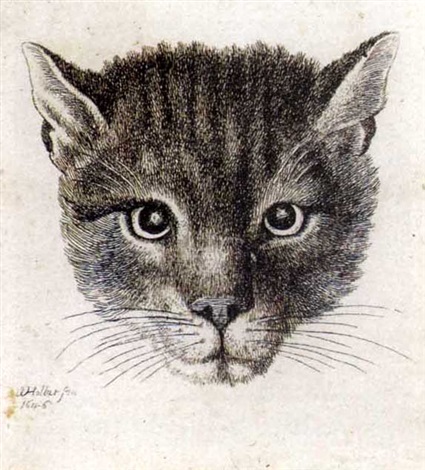
Wenceslaus Hollar (July 13, 1607 to March 25, 1677) was an engraver, born in what is now the Czech city of Prague.  Here is an example of his work though not one  which made him famous---

The small cats head by Wenceslaus Hollar on artnet

According to the University of Toronto:

Hollar was born in 1607, the son of an upper middle-class civic official. Very little is known about his early life, but he evidently learned the rudiments of his craft by age eighteen, left his native Prague at age twenty, and likely studied in Frankfurt under Matthaus Merian. His first book of etchings was published in 1635 in Cologne when Hollar was twenty-eight. The following year he came to the attention of the renowned art collector the Earl of Arundel who was making an official visit to the continent, and Hollar subsequently became a part of his household, settling in England early in 1637. He remained in England during the beginning of the English Civil War period, but left London for Antwerp in 1642, where he continued to work on a variety of projects. In 1652 he returned to England, working on a number of large projects for the publisher John Ogilby and for the antiquary Sir William Dugdale. Hollar was in London during the Great Fire of 1666, and remains most famous for his scenes of the city before and after the fire. He was one of the most skilled etchers of his or any other time, which is all the more remarkable given that he was almost blind in one eye. Hollar died in London on 25 March 1677. By his life's end, he had produced some 2700 separate etchings.


The university has a large collection of prints from etchings that Wenceslaus Hollar made, online, and you can see more of  them here.

July 12, 2020

July 12, 1817

Henry David Thoreau (July 12, 1817 to May 6, 1862) was one of the founding geniuses of American culture. Being a transcendentalist however, did not mean his sojourns in the woods were quite as solitary as you might think. He managed to drop his laundry off for Mrs. Emerson to wash.

But the exemplar of Emerson's "Self-Reliance", does do without domestic animals:

I kept neither dog, cat, cow, pig, nor hens, so that you would have said there was a deficiency of domestic sounds; neither the churn, nor the spinning-wheel, nor even the singing of the kettle, nor the hissing of the urn, nor children crying, to comfort one. An old-fashioned man would have lost his senses or died of ennui before this. Not even rats in the wall, for they were starved out, or rather were never baited in, — only squirrels on the roof and under the floor, a whippoorwill on the ridge-pole, a blue-jay screaming beneath the window, a hare or woodchuck under the house, a screech-owl or a cat-owl behind it, a flock of wild geese or a laughing loon on the pond, and a fox to bark in the night...

He can boast that he has "no path to the front-yard gate in the Great Snow, — no gate — no front-yard, — and no path to the civilized world!" It is these circumstances that allow a
"[s]ympathy with the fluttering alder and poplar leaves [that] almost takes away my breath..."

Thoreau however was interested in stories of a "flying cat," and traveled to see one. This was before his setting up house on Walden Pond. The cat in question was out hunting when he arrived but the thought of such a creature occupied his thoughts. He says:

Some thought it was part flying squirrel or some other wild animal, which is not impossible, for, according to naturalists, prolific hybrids have been produced by the union of the marten and domestic cat. This would have been the right kind of cat for me to keep, if I had kept any; for why should not a poet's cat be winged as well as his horse?

Indeed.